
Pet Logic Lab: Using an Outdoor Winter Cat Shelter for Strays
The Quick Take: Is your outside cat safe in Sub-Zero Temps?
When winter temperatures drop, stray and feral cats face an immediate risk of hypothermia and frostbite. If you have a neighborhood stray frequenting your porch, a basic plastic box isn’t enough. Have you considered using an outdoor shelter for a stray?
Our Top Lab Recommendation: To bypass the guesswork of DIY setups, we rely on the commercially vetted, thermostatically controlled Outdoor Heated Kitty House (Amazon Link). Featuring a thermostat controlled heating pad that automatically responds to a cat’s body weight, it is the single most reliable tool to keep outdoor cats safe, warm, and dry through the harshest winter nights.
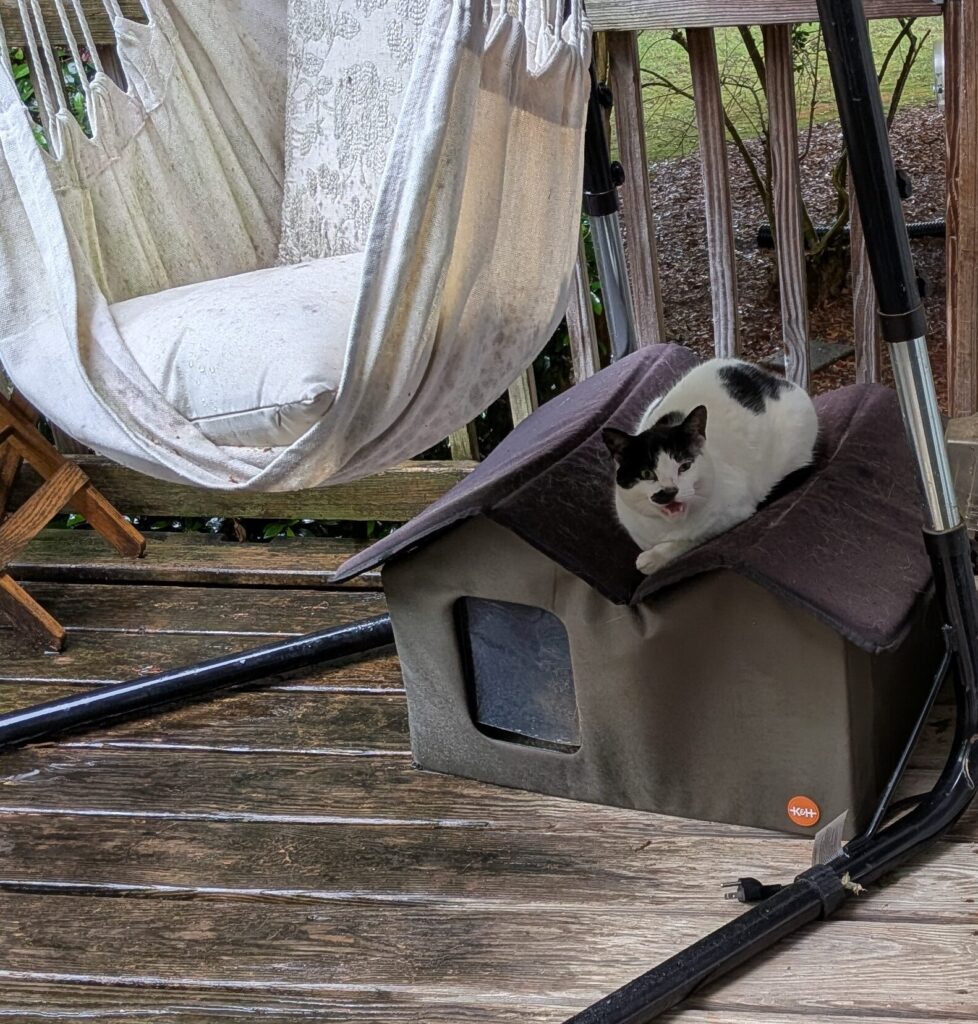
Our Porch Visitor: Meeting our Stray cat Cowie
She was completely wild. She wouldn’t let us within ten feet of her, hissing if I stepped too close. But as the wind howled and the thermometer plunged deep into the single digits, it became painfully clear that her survival depended on an unwritten agreement between us: I would provide the heat, and she would need to trust us. (Please read Rendi’s version of these events on her blog about the similar subject.)
We named her Cowie. Watching her tentatively navigate her way onto our porch changed how I viewed cold-weather animal care. It wasn’t about simply offering a cardboard box with an old towel; it was about understanding biological thermodynamics and neuroscience to save a life.
While cats are incredibly resilient, they are fundamentally desert creatures by evolutionary design. Whether you trace their roots to Egypt or the Middle East, they were from dry and arid climates with heat and a much smaller demand for water than dogs. Their baseline body temperature rests significantly higher than ours, sitting between 100F to103F.
According to veterinary data published by the Tufts University Cummings School of Veterinary Medicine, when ambient outdoor temperatures fall below 45F, a cat’s body must actively expend extra metabolic energy just to maintain core homeostasis.
The Neurobiology of Calming a Stray
The Neurobiology of Calming a Stray
When we first set up our system, Cowie was incredibly defensive. However, we have noticed a profound shift: she is visibly calming down every time we feed her and when she relies on the outdoor shelter.
This isn’t just Cowie “getting used to us” there is a fascinating neurological transformation taking place.
According to the Feline Behavior Guidelines published by the American Association of Feline Practitioners (AAFP), a stray or feral cat living outdoors is trapped in a chronic state of sympathetic nervous system arousal the classic “fight-or-flight” response. When an animal is freezing, its brain prioritizes immediate physical survival over social bonding or behavioral conditioning. Fear and self-defense rule their actions because their energy reserves are depleted.
| Feature | DIY Plastic Tote + Straw | Cheap Wooden Feral Boxes | Outdoor Heated Kitty House (Amazon Link) |
| Heat Source | Passive (Cat’s body heat only) | Passive (No retention) | Active (Thermostatically Controlled Pad) |
| Moisture Risk | High if rain blows inside | Extreme (Wood absorbs water) | Zero (Water-resistant denier polyester) |
| Escape Routes | Poor (Usually only 1 door) | Poor (1 door) | Perfect (Dual exits with clear flaps) |
| Setup Time | 1–2 Hours (Cutting, packing) | 45 Minutes (Assembly) | Under 5 Minutes (Hook-and-loop velcro walls) |
| Lab Safety Score | 7/10 | 4/10 | 9/10 |
Sources / Bibliography
- American Association of Feline Practitioners (AAFP). Feline Behavior Guidelines: Understanding Environmental Management and Stress Reduction in Free-Roaming Canines and Felines.
- American Society for the Prevention of Cruelty to Animals (ASPCA). Winter Weather Protocols for Community and Feral Cat Management.
- Tufts University Cummings School of Veterinary Medicine. Clinical Briefing on Metabolic Homeostasis and Hypothermia Risks in Free-Roaming Felids.