
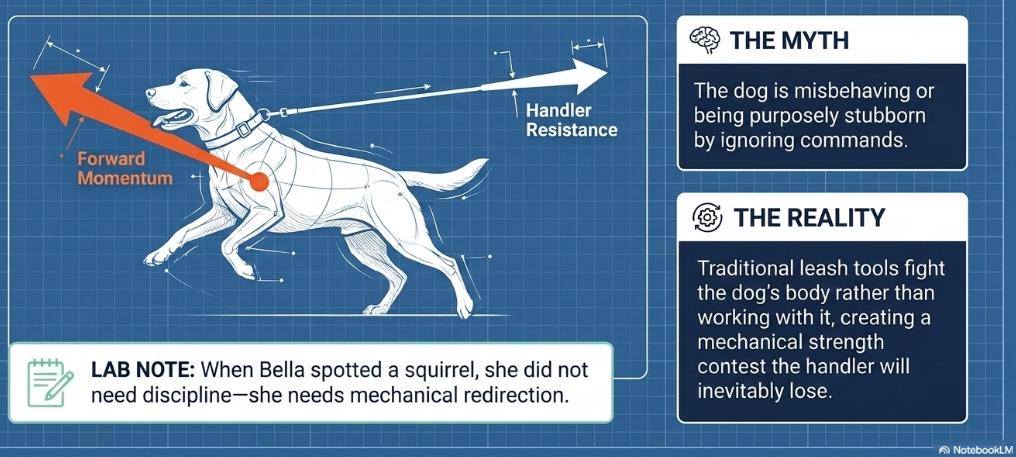
My beloved Chocolate Lab, Bella, used to pull me around the hiking trails, yank me down the street, bolt after cars, and, in general, make walking a real chore. This is while I was supposedly in control of her with the leash. I questioned my authoritativeness and began researching all types of collars which might “teach her a lesson” or “show her who was boss”.
As an analytical person, I really try to use the science of how dogs move and think to formulate my decisions. I eventually chose a gentle leader style of harness that goes around the dog’s face like a horse halter. While “choke” or “prong” collars were once the industry standard, modern meta-analyses—large-scale reviews of hundreds of data points—have fundamentally changed our understanding of canine safety. My wife, Rendi, was not going to allow me to use those mean collars anyways and the science completely backs her beliefs for so many reasons.
Protecting the Fragile Neck Anatomy and Ocular Health
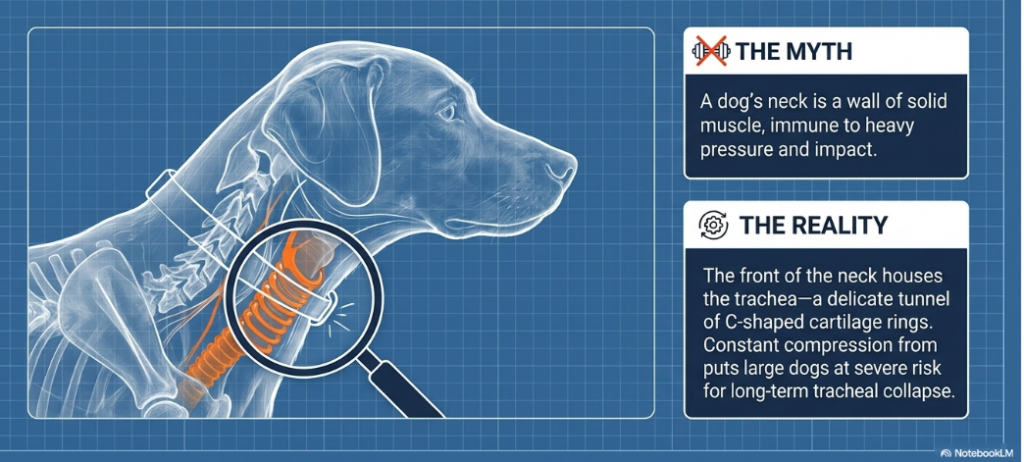
Many owners assume a dog’s neck is a wall of thick muscle. In reality, the front of the neck houses the trachea (windpipe), a series of delicate, C-shaped cartilage rings that are easily compressed. Though research varies by specific breed of dog, damage can be done by extreme pulling of a traditional collar forced upon the treachea. I prioritized Bella’s long-term health, and the data justifies that concern.
- Recommendation: Even “comfort” collars put enough force on the trachea to cause damage.
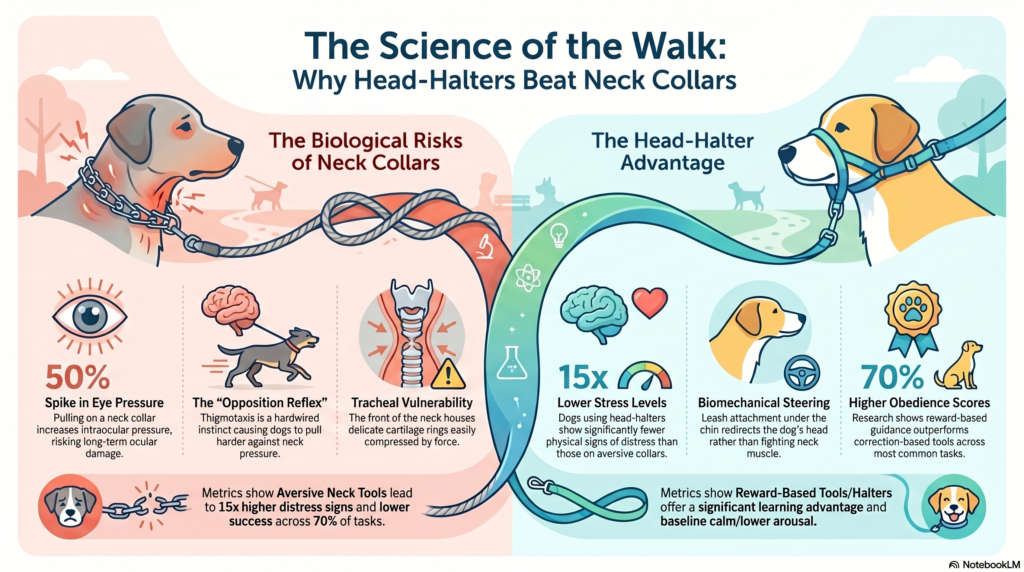
Additionally, a landmark study by Pauli et al. demonstrated that a single “pull” on a neck collar causes a significant spike in the dog’s heart rate and intraocular pressure (fluid pressure in the eye), increasing it by over 50% from normal baseline measures [1].
- Recommendation: Authors stated collars for dogs with vulnerable eye conditions should be avoided entirely in favor of harnesses to prevent these dangerous pressure spikes.
Why Gentle Leaders Work Better: Bypassing the “Opposition Reflex”
Bella isn’t being “stubborn” when she pulls against a regular collar; she’s reacting to thigmotaxis, or the technical term for opposition reflex. This is a hardwired physical instinct to lean into pressure. It is not your imagination, the dog really is pulling against you! It is in their DNA to do so.
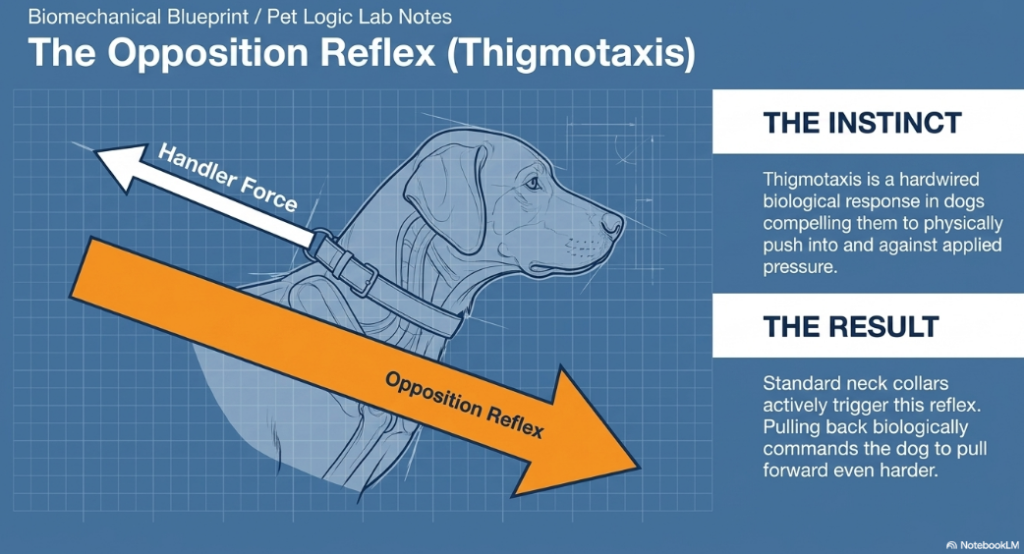
I love the Gentle Leader because it uses mechanical leverage instead of force. Because the leash attaches under a dogs chin, it is acting more like a “steering wheel.” So you will no longer be fighting muscle with muscle, you are using something that is lowering her physiological arousal [3]. High physiological arousal (stress, excitement, or frustration) is physically reinforced by neck pressure so the dog will not respond as well to your training efforts.
Who will the data support? Choke Collar vs. Gentle Leader
Lastly, to make sure I was making the right choice for Bella, I looked at the largest research study I could find: the Ziv (2017) Meta-Analysis [2]. This study synthesized data from 17 different peer-reviewed articles involving over 3,500 dogs. The numerical trends are staggering:
- 0% Advantage: Out of 17 major studies, zero found that aversive neck-based tools taught dogs faster or more effectively than reward-based tools.
- The “Stress Gap”: In controlled settings, dogs on aversive collars displayed an average of 15 times more physical signs of distress (like lip licking and yawning) compared to dogs using positive tools.
- Success Rates: One large-scale survey within the analysis showed that reward-trained dogs had significantly higher obedience scores across 70% of common tasks compared to those trained with corrections.
Bibliography & Verified Sources
- Pauli, A. M., Bentley, E., Diehl, K. A., & Miller, P. E. (2006). “Effects of the application of neck pressure by a collar or harness on intraocular pressure in dogs.” Journal of the American Animal Hospital Association.
- Ziv, G. (2017). “The effects of using aversive training methods in dogs—A review.” Journal of Veterinary Behavior. (View Table 1 on page 54 for full numerical breakdown).
- Vieira de Castro, A. C., et al. (2020). “Does training method matter? Evidence for the negative impact of aversive-based methods on companion dog welfare.” PLOS ONE.
- American Veterinary Society of Animal Behavior (AVSAB). (2021). “Position Statement on the Use of Punishment for Behavior Modification.”